The Violent Art
Notes on the examined life

On the violence
There’s a line in Matthew’s gospel that has always captured my attention: “The kingdom of heaven has suffered violence, and the violent take it by force.” It sounds wrong at first — aggressive, almost martial, not the kind of language we associate with spiritual life in an age that prefers its religion soft and its spirituality therapeutic. But the more I sit with it, the more I think it’s one of the most honest things ever said about what genuine transformation requires.
The violence here isn’t aggression against God. It isn’t forcing your way past a reluctant deity. It’s the force you have to bring against yourself. Against the habits of years, against the grooves worn deep by patterns you chose and then stopped choosing and then forgot you could refuse. It’s the daily resistance to what is easier and more familiar and more immediately comfortable than the thing you’re actually after.
Anyone who has tried to change something fundamental about themselves knows exactly what this violence feels like. Not the dramatic violence of crisis - though that has its place, and I’ve been acquainted with it - but the quieter, more grinding violence of waking up again and doing the thing again and not quitting again. The force required to keep moving when everything in you has negotiated a very reasonable case for stopping.
I’ve needed that force. I’ve also, many times, not had it. The starts and stops of my adult life are a record of what happens when you can see where you need to go but can’t sustain the force to keep moving toward it. I’m not offering this as confession for its own sake. I’m offering it because I think a lot of men are living that record right now, and calling it weakness isn’t actually that useful. The problem isn’t usually a lack of desire. The problem is a lack of a framework serious enough to hold the desire, and a lack of understanding about what the journey actually costs.
So there’s the violence: not cruelty, not aggression, but the necessary force that a serious life requires. The kingdom doesn’t come to those who wait passively for it. It comes to those who press toward it with everything they have, including on the days when everything they have is barely enough to get out of bed.
On the art
I call it an art because it isn’t a science. There’s no formula. There’s no protocol you follow correctly and then arrive. There are principles - serious ones, worth examining with everything you’ve got - but principles are not algorithms. They’re more like orientations. Knowing which direction to face isn’t the same as knowing how to walk.
An art requires judgment. It requires the kind of practical wisdom that can’t be fully transmitted in a book, that has to be earned through encounter with actual material in actual conditions. A painter can study color theory for years and still not know how to paint until he picks up the brush and starts failing in front of a canvas. The theory serves the practice, not the other way around.
There’s something else about art that matters here. Art is an act of creation. When you take the raw material of a disordered life and begin to work it toward something ordered, something whole, something that participates in the Good rather than merely depleting it - that is a creative act. It is, I would argue, the most fundamental creative act available to a human being. You are making something that did not exist before: a person who sees more clearly, acts more rightly, and loves more truly than the person who existed before the work began.
And like all genuine creation, it is never finished. You don’t complete it. You practice it. The examined life isn’t a project with a conclusion. It’s a discipline with a direction.
What I’m working with
Three tools. Three disciplines that have been, for me, the primary means of pursuing the examined life.
Orthodoxy — the ancient Christian faith of the Eastern Church, with its Divine Liturgy, its ascetic tradition, its theology of theosis, its insistence that the human person is made in the image of God and called to participate in the divine life. This is my orientation. The direction the soul is turned.
Stoicism — or more precisely, something in the neighborhood of Stoicism and Aristotelian virtue ethics. The tradition of Epictetus and Marcus Aurelius, of internals and externals, of the right use of impressions, of self-examination as a daily discipline. This is my disposition. The trained state of the inner life.
Calisthenics — in the oldest sense of the word. From the Greek kalos, beautiful, and sthenos, strength. The disciplined and intentional care of the body is the physical ground of a human life. Not aesthetics. Not performance. The stewardship of the body as what it actually is: the arena of the soul, the material of a life, and, according to our faith, the future object of a resurrection. This is my expression. Incarnational, embodied, existential.
These are not three subjects. They’re three instruments. They enter the work when the piece calls for them. They recede when it doesn’t. The pursuit is primary. The tools serve it.
On Christ
I should say plainly what I believe this is ultimately about, because leaving it vague would be a kind of dishonesty, and this project has no use for dishonesty.
The examined life I’m pursuing is a pursuit of a well-lived life in Christ. Not in the sense of a life that follows a checklist, or performs religious correctness, or presents itself as spiritually put-together. In the sense of a life oriented toward the One who is himself the integration of all the things we are trying to become: fully alive, fully human, fully ordered, fully giving.
The Orthodox tradition I’m being formed in speaks of Theosis - the participation of the human person in the divine life. This is not absorption, not the loss of the self, but its fullest realization. The icon doesn’t disappear into the light. The light comes through it and makes it more fully what it was made to be. That is the end toward which the Violent Art moves.
The point of the Christian life is not primarily ethical. It is ontological. It is not primarily about changing what you do. It is about changing what you are. Because if you change what you are, what you do changes as a matter of course. You don’t produce better fruit by polishing the fruit. You change the tree. This is the difference between modification and transformation. It is also the difference between self-help and what I’m attempting here.
I’m not going to pretend I have this figured out. I have spent most of my life pointed in the wrong direction with considerable energy and enthusiasm. But here is what I know, as much as I know anything: the framework holds. The architecture of this examined life - body, soul, and spirit engaged together, oriented toward the Good, practiced daily through prayer and discipline and attention - this is, for me, not just a “nice idea.” It’s real. More real than the disorder it’s meant to address. More real than the comfortable settling I spent decades mistaking for contentment.
On the starts and stops
I want to say something honest about failure, because any account of this project that doesn’t reckon with failure is lying to you.
In the course of forty-seven years, I have managed to fail in every conceivable area: educationally, vocationally, personally, financially, morally. There is no area of life that I haven’t demolished. My deepest fear came true. I became my father. And in becoming him, I discovered something I couldn’t have found any other way: that there was nothing left to protect. That freedom, of a certain kind, lives on the other side of the thing you were most afraid of losing.
I have had the realization - the one where it becomes suddenly clear that you’ve been living wrong and that you don’t have to, that the other road exists and you could take it - I have had that realization more times than I can count. And more times than I can count, I have let the momentum dissipate. The insight fades, the habit doesn’t form, the next difficulty hits before the new orientation has any roots, and you find yourself again in territory you thought you’d left.
What I understand now that I didn’t understand in those earlier attempts is the difference between insight and formation. Insight is fast. Formation is slow. Insight tells you where you need to go. Formation is what makes you capable of getting there and staying there. You cannot think your way to the destination. You have to be made into the kind of person who can reach it, and that making takes time and repetition and the willingness to fail without quitting.
The starts and stops aren’t evidence that the project doesn’t work. They’re evidence that I kept underestimating what it required. The goal keeps expanding as the person grows toward it. That’s not discouraging, or it shouldn’t be. It means life is bigger than you thought.
What this is and isn’t
This is not self-help. Self-help assumes the self is the problem and the self is the solution, which is exactly half right and therefore mostly wrong. The self is certainly involved. But the work isn’t about optimizing the self. It’s about orienting the self - toward something real, something outside itself, something that doesn’t move when everything else does.
This is not therapy, though the examined life has therapeutic effects. It’s not philosophy, though it draws from the best philosophy has to offer. It’s not religion in the sense of performance or identity-maintenance.
I am not authoritative. I am authentic. Or trying to be. The distinction is the difference between writing from arrival and writing from pursuit. I have not arrived. I am pursuing. I’m not writing from the mountaintop. I’m writing from the foot of it, making my way up, one word at a time. What I offer is not expertise. It’s an honest pursuit — theological, philosophical, physiological — of a life worth living. And the occasional hard-won lesson from a man who learned most of what he knows the hard way.
Life is one. There is no spiritual life and secular life. There’s only life. The sacred-secular divide is a lie that benefits no one and impoverishes everyone. The Incarnation — God becoming flesh, the logos taking up residence in matter — is the definitive theological statement that the physical and the spiritual are not enemies but partners, not separate departments but a single reality viewed from different angles. What I’m after is a human life, lived deliberately, with eyes open, moving toward the Good.
The Struggle
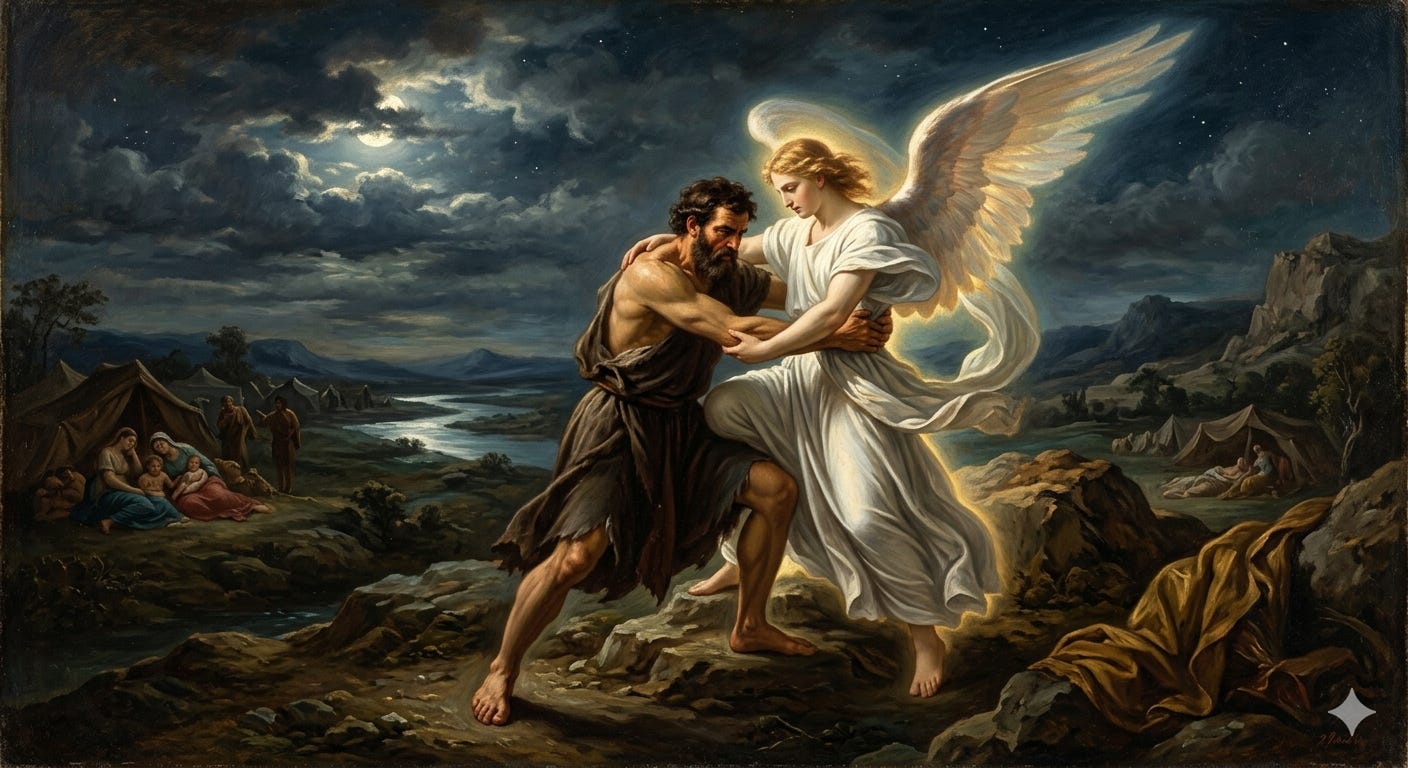
Jacob didn’t wrestle the angel on behalf of anyone. He wrestled because he needed the blessing. The gift to the world came through the wrestling, not instead of it.
These essays are the expression of that wrestling. Public, imperfect, ongoing, and offered without apology.
The examination is violent because reality is violent - not malicious, but demanding, unyielding, indifferent to our preferences about what it should be. To examine your life honestly is to encounter things you would prefer not to see. To act on what you see requires force. To sustain that action requires everything you have, and then the grace to go further than what you have.
The art is in how you do it. Not perfectly. Perfection is not the goal and never was. But faithfully. With whatever you have today. One step, then another, then another, in the direction you’ve chosen and keep choosing, because the alternative is a life you already know you don’t want.
That is the Violent Art. That is what I’m after.
I’m not there yet. But I know which way I’m facing. And that, for now, is enough to keep moving.
A note on method: these essays are attempts in the oldest sense of the word — published as current perspectives, not final verdicts. Some will be revised in light of genuine friction. Some will be superseded by better thinking. None claims the last word. The pursuit is ongoing and the writing reflects that. If you’re looking for a system or a set of conclusions, you’re in the wrong place. If you’re willing to think alongside someone working his way through things honestly, you’re in exactly the right one.